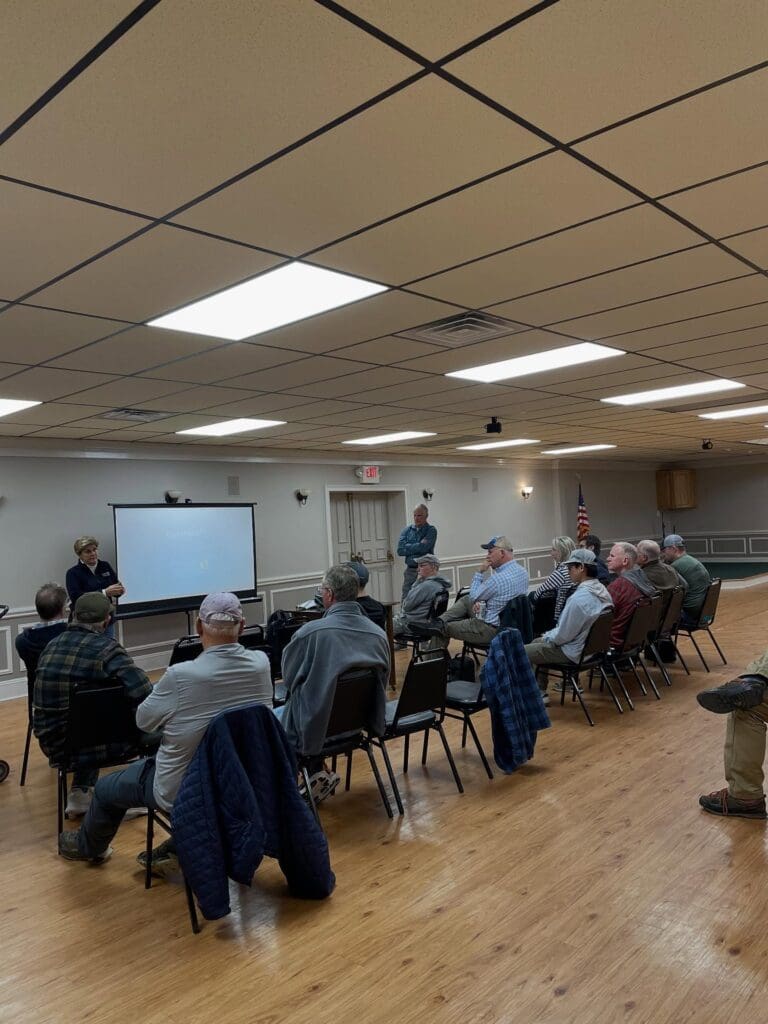
October 30, 2025 – We had the pleasure of hosting Beth Styler Barry, Director of Freshwater Programs at The Nature Conservancy in New Jersey, at our October 15 chapter meeting at the Califon Firehouse. Beth came to share the remarkable progress being made in dam removal efforts across our state, and the turnout was excellent – our members clearly recognize the importance of this work for New Jersey’s coldwater fisheries.
Beth, who leads the New Jersey Statewide Dam Removal Partnership (SDRP), brought inspiring news about historic achievements in reconnecting our fragmented waterways. With over 20 years of experience in river restoration and a background that includes serving as Executive Director of the Musconetcong Watershed Association for over 15 years, she’s become a leading voice in the movement to free New Jersey’s rivers from obsolete dams.
“New Jersey’s rivers are disconnected by more than 1,700 dam structures, many of which have outlived their usefulness,” Beth explained to our group. “These outdated dams degrade water and habitat quality, contribute to community flooding, and pose dangers to recreational paddlers while creating liability risks for their owners.”
The Paulins Kill Success Story
The highlight of Beth’s presentation was The Nature Conservancy’s systematic removal of four major dams along the Paulins Kill River. The Columbia Dam removal in 2019 – a massive structure spanning 330 feet wide and 18 feet tall – was the largest dam removal in New Jersey history at the time. This was followed by the County Line Dam in 2022 and most recently, the Paulina Dam in Blairstown in 2024. Together, these removals have reopened 45 miles of mainstem river and tributaries to spawning American shad for the first time in over a century.
Our members were particularly interested in the environmental impact of these projects. Beth shared encouraging monitoring data from the Paulins Kill showing that water temperatures upstream and downstream of former dam sites have become more consistent, macroinvertebrate populations are thriving, and – perhaps most exciting for us as anglers – American shad and sea lamprey have been documented migrating to the farthest upstream reaches of the river for the first time in generations.
Strong Partnership with Trout Unlimited
What really resonated with our chapter was learning about the deep partnership between The Nature Conservancy and Trout Unlimited. TU is an active member of the Statewide Dam Removal Partnership that Beth leads, alongside American Rivers, the Natural Resources Conservation Service, U.S. Fish and Wildlife Service, and numerous watershed associations.
“The collaborative spirit between our organizations is essential,” Beth noted. “Trout Unlimited’s dedication to protecting coldwater fisheries aligns perfectly with our mission to restore connectivity in New Jersey’s rivers.”
Looking Forward
Beth also discussed The Nature Conservancy’s current priorities, including reconnecting the Lower Pequest River with the recent removal of the Cedar Grove and No Name dams. They’re also advancing the removal of the Lower and Upper E.R. Collins Dams, which will restore access to three additional miles of spawning habitat.
The urgency of this work became clear when Beth shared that 558 of New Jersey’s 1,702 regulated dams rank as “high and significant hazard” – nearly one in three dams in the state carry potential risk to public safety.
Engaging Discussion
The presentation was very well received, with our members asking numerous questions about the environmental impacts of dam removal, the technical aspects of the work, and specific improvements to fisheries they’ve observed. Several members were curious about the effects on both resident trout populations and migratory species, while others asked about sediment management and how quickly ecosystems recover after dam removal.
Beth explained how The Nature Conservancy is building capacity for future dam removals by training new contractors and engineers. They’ve hosted workshops that have attracted over 250 participants and identified 15 additional dams where removal is being investigated.
One particularly interesting point that sparked discussion was Beth’s mention of her time with the Musconetcong Watershed Association, where dam removals on that river opened about 5 miles to migratory fish. Several of our members who fish the Musky regularly shared their observations of improved fishing conditions in recent years.
Why This Matters to Us
As the Ridge and Valley Chapter, we’re committed to protecting the exceptional trout waters of northwestern New Jersey. Beth’s presentation reinforced how dam removal directly benefits the coldwater fisheries we work so hard to protect. The successful partnership between TU and The Nature Conservancy demonstrates that collaborative conservation can achieve landscape-scale restoration even in America’s most densely populated state.
We’re grateful to Beth for taking the time to visit our chapter and share these success stories. Her passion for river restoration is contagious, and her work gives us hope that New Jersey’s rivers can be restored to their full potential – benefiting both the fish we love and the communities that depend on healthy waterways.
For those interested in learning more about The Nature Conservancy’s dam removal efforts in New Jersey, visit njdams.org.
If you missed this presentation and would like to learn more about upcoming chapter meetings and speakers, check our events calendar or join us on the third Wednesday of each month at the Califon Firehouse.
Pingback: prinzide
Pingback: atorvastatin calcium 80 mg
Pingback: stromectol price south africa
Pingback: doxycycline hyclate 100 mg capsule
Pingback: linezolid 600 mg price